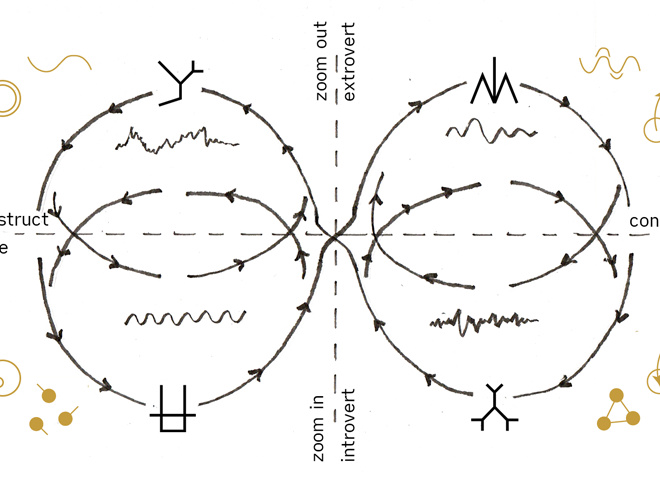
Polysingularity is a condition where multiple solutions are possible and yet only some are actualized at any moment of time. It’s a study of how affordances (or environmental opportunities) come into contact with the human capacity to believe and make choices. Polysingularity is best described through the framework of networks where the node’s current state and future condition is dynamically determined by its specificity as well as the multiplicities it belongs to.
In this research (supplemented with a concise slide presentation) we are showing how rumours propagate through networks, how to communicate information to a large group of people efficiently, what makes a message viral, and – most importantly – how the framework of network analysis can enhance our understanding of communication in society. This research was presented at betahaus in February 2012.
Venture fiction is a practice of creating enterprises in order to communicate ideas and not the other way round. It uses the framework of network analysis to conceive of itself and its interactions with the real. Each iteration is a shift from one node to another within a dynamic network, which has capabilities to produce both wandering movement and oscillating multidimensional patterns. Each venture is a strange attractor among many and it is the fiction that propels the entrepreneur to travel between them and to create the new ones.
This is a report on the experiment that Nodus Labs conducted on some of the more active Russian protest Facebook groups formed after the rigged Russian election in 2011. We made two network visualizations for three different protest groups over a period of one month in order to observe their dynamics. We found that the most influential members of these groups were not too politically engaged before the elections and were mainly journalists, students, event organizers, and media workers. We also found that the groups formed around ideological causes (such as “Putin must leave”) stagnated in their development in January 2012, while the groups formed around a call for active participatory actions (“Volunteers for the fair elections”) have grown in size and density considerably, building a very well connected and yet open network that was able to bring many new members together around their cause.
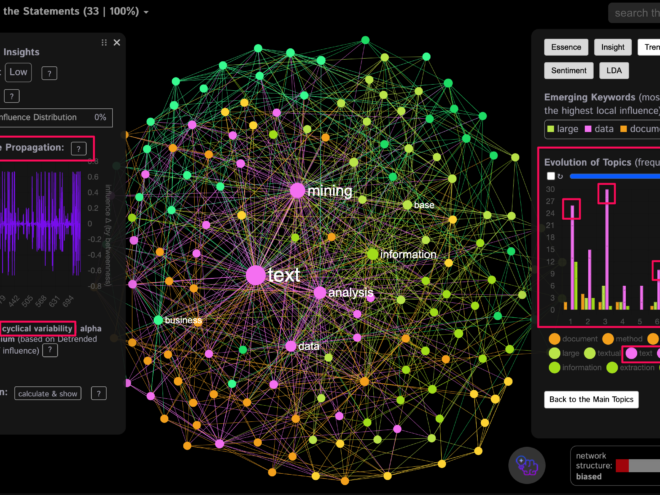
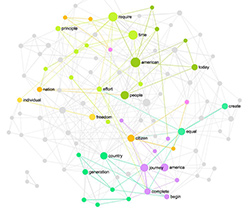
In this research we propose a method for visualizing text’s polysingularity: the multiple clusters of meaning circulation contained within a text. These clusters can be described as “strange attractors” (to use the term from dynamical systems theory), which are actualized during the process of reading. We use network analysis in order to plot the text’s structure onto a two-dimensional plane and represent these strange attractors as the communities of co-occurring nodes, positioned within the graph depending on their influence for the production of meaning.