Interfaces are all-pervading and their ability to enhance our communication and lives creates an almost religious devotion to technology. The ability to grant an instant gratification and expand our mind puts technology on the same level as drugs: highly addictive, could be dangerous in high dosage, very helpful and sometimes mind-blowing when consumed moderately. My proposition, drawing upon the ideas of Agamben, Foucault, and Kurzwell, is to de-sacralise what we’ve learned so far from the interfaces and to make it profane. Let’s embody the interfaces and bring the magic into the everyday life to allow the free reign of polysingularity.
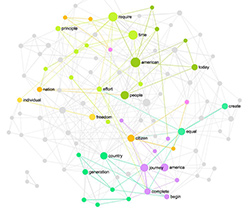
In this work we propose a method and algorithm for identifying the pathways for meaning circulation within a text. This is done by visualizing normalized textual data as a graph and deriving the key metrics for the concepts and for the text as a whole using network analysis. The resulting data and graph representation are then used to detect the key concepts, which function as junctions for meaning circulation within a text, contextual clusters comprised of word communities (themes), as well as the most often used pathways for meaning circulation.
In order to maintain a certain degree of openness and flexibility that would extend beyond the short-term goals, professional networks must practise “inclusive exclusivity” – that is, maintain tightly-knit clusters but only temporarily, allowing for the new individuals and communities to enter from the periphery towards the center of the network. Nodus Labs research based on the study of PAF and INPEX – two cultural networks working in the field of contemporary dance. November, 2011.